
Fundraising Ideas for Military Families
When a military family in your community needs support, most people want to help, but they aren’t always sure where to start.
When looking for military fundraising ideas, the best fundraisers are the ones that make it easy for people to participate, connect with a meaningful mission, and bring the community together in support of military families and service members.
Explore these 30+ military fundraising ideas to find an option that fits your community, resources, and goals:
- Community BBQ Fundraiser
- Patriotic Potluck Dinner
- Benefit Concert
- Military Appreciation 5K
- Charity Walkathon
- Community Gala Night
- Family Fun Day
- Golf Tournament
- Patriotic T-Shirt Sale
- Challenge Coin Campaign
- American Flag Subscription Program
- Branded Merchandise Store
- Peer-to-Peer Fundraising Campaign
- Online Giving Day
- Facebook Fundraiser
- Livestream Fundraiser
- Corporate Matching Gift Drive
- Employee Giving Campaign
- Volunteer Hour Matching Program
- Local Business Sponsorship Campaign
- Silent Auction
- Online Auction
- Handmade Craft Sale
- Quilt Auction
- Holiday Gift Basket Raffle
- Hug-a-Gram Fundraiser
- Beard Growth Challenge
- Patriotic Dress-Down Day
- Penny Wars Competition
- Military Trivia Night
- Marine Corps Ball Fundraiser
- Army Unit Support Event
- Deployment Care Package Drive
- Homecoming Celebration Fundraiser
- Military Awareness Walk
This guide covers how to choose the right fundraiser for your group, explore 30+ ideas across every budget, identify which efforts bring the highest returns, apply the 80/20 rule to maximize results, plan for real costs, and promote your event to the right audience.
How to Choose the Right Military Fundraiser for Your Group
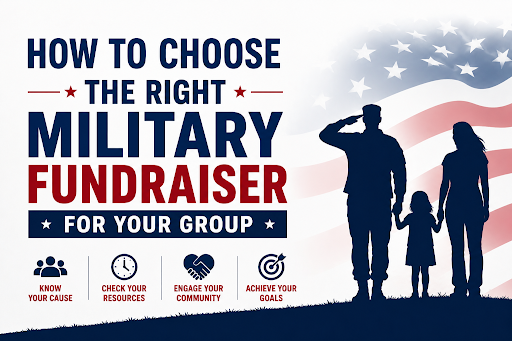
The most successful military fundraisers are the ones that fit your community, available resources, and fundraising goals.
Match the Cause to Your Community
People are more likely to support a fundraiser when they understand exactly who it helps and why it matters.
A school may choose to support military children through a community event, while a civic organization may focus on care packages for deployed troops or military appreciation activities.
The fundraiser itself matters, but the connection people feel to the cause often matters even more.
Check Your Budget, Timeline & Volunteer Capacity
Choose an event based on what you can realistically manage:
- Limited budget and volunteers: Care package drives, online campaigns, potlucks, or school spirit days.
- Moderate resources: Community BBQs, trivia nights, silent auctions, or appreciation dinners.
- Larger teams and longer timelines: 5Ks, golf tournaments, benefit concerts, or gala events.
The best fundraiser is one your group can confidently organize, promote, and sustain.
How can I help military families in my community? Check in with local military families and ask what they actually need, then help with practical support like meals, childcare, rides, school supplies, or connecting them to local military family organizations and resources.
You can also volunteer, donate to trusted military-support charities, or organize a small community drive for care packages or emergency assistance.
30+ Military Fundraising Ideas for Every Budget and Community
The ideas below highlight different military fundraising events, making it easier to find an option that matches your community, budget, audience, and level of involvement.
Community & Event-Based Military Fundraising Events
Community events bring people together around a shared purpose and often generate strong local participation.
- Community BBQs are flexible military fundraisers because it feels social, and revenue can come from ticket sales, raffles, sponsorships, and food donations.
- Patriotic potluck dinners work best for unit families, FRGs, and neighborhood-style support groups. Participants contribute a dish while making a small donation to attend.
- Benefit concerts can raise more money, but they need performers, sound equipment, seating, and permits. They work best with a built-in audience and a clear patriotic or service-themed program.
- Walkathons and military appreciation 5Ks attract participants, sponsors, and volunteers. The main costs are route planning, water, signage, timing, insurance, and safety support.
- Galas are high-end fundraising events designed for larger donations and sponsor relationships. They usually require a venue, catering, ticketing, decor, program setup, and formal outreach.
At America Supporting Americans , we help schools, businesses, and local organizations build meaningful connections with active-duty military units through programs like community-unit adoption and military engagement opportunities and provide ongoing support throughout the year.
If you’re planning a larger fundraiser, our Nonprofit Event Planning Checklist can help streamline the process.
Merchandise & Product Fundraisers
Product-based fundraisers allow supporters to contribute while receiving something tangible in return.
- Patriotic t-shirts remain effective fundraising products because strong designs and unit or cause-specific branding usually matter more than the shirt itself.
- American flag subscription programs are useful because they work as recurring fundraisers, especially around holidays and observances.
- Custom merchandise stores featuring hats, tumblers, decals, tote bags, or challenge coins can generate ongoing revenue if sold at meetings, events, and online because they are practical and identity-driven.
- Patriotic yard signs also work well for community-wide campaigns and military appreciation initiatives.
Online & Crowdfunding Fundraisers
Online fundraising expands your reach beyond your immediate community.
- Peer-to-peer fundraising campaigns are lowest-cost options because you are paying mostly for communication, not event production. These allow supporters to create individual fundraising pages and encourage friends and family to contribute
- Online giving days help create urgency around a specific fundraising goal while encouraging social sharing.
- Facebook fundraisers and social media campaigns can increase visibility and attract smaller donations from a larger audience.
- Livestream fundraising events combine storytelling, interviews, and community engagement in a digital format.
How much does GoFundMe take out of $10,000? For a $10,000 GoFundMe, the standard U.S. processing fee is about $290 + $0.30 per donation; the exact total depends on how many donations you get. In simple terms, GoFundMe usually takes around 3% plus 30 cents per gift, not a flat cut of the whole $10,000.
For a detailed breakdown of fundraising platforms, see Best Donation Platforms Compared.
Corporate & Matching Gift Fundraisers
Businesses often want to support military families while engaging employees in meaningful community initiatives.
- Matching gift drives encourage employees to donate while employers match contributions.
- Volunteer-hour matching programs allow companies to provide financial support based on employee volunteer hours. This is strongest when volunteers can document their participation clearly.
- Employee giving campaigns can be organized throughout the year and promoted internally through workplace communications.
- Business sponsorship campaigns provide companies with an opportunity to support community-focused military initiatives while increasing local visibility.
Auctions & Craft-Based Fundraisers
Auctions create excitement while allowing donors to contribute items instead of direct cash donations.
- Silent auctions are events where people bid on items quietly, and they work at community events, appreciation dinners, and galas. These work best when donated items are desirable, local, or experience-based.
- Online auctions expand participation by allowing supporters to bid remotely.
- Quilt auctions remain a popular option for churches and community groups with skilled volunteers, where handmade quilts are donated and then sold to the highest bidder, either in person or online.
- Handmade craft sales featuring artwork, woodworking, holiday decorations, or homemade goods can generate support while showcasing local talent. They suit smaller groups with limited budgets and volunteers.
- Gift basket raffles are simple to organize and encourage participation through affordable ticket prices.
Creative, Low-Cost Fundraising Ideas
Not every fundraiser requires a large budget or extensive planning.
- Hug-a-Grams are cheap, easy to run, and fun for schools or workplaces where a small gift or message is delivered to someone in exchange for donations.
- Beard growth challenges work by turning a visible personal change into a donation prompt. They encourage participants to collect pledges while growing facial hair over a designated period.
- Patriotic dress-down days are among the easiest fundraisers because participants pay for a casual dress privilege. They work especially well in schools and workplaces.
- Penny Wars competitions create friendly competition between classrooms, departments, or community groups while raising funds.
- Military trivia nights combine entertainment and fundraising in a low-cost format that appeals to a broad audience.
Branch-Specific & Occasion Fundraisers
Some fundraisers are built around military traditions and milestones.
- Marine Corps Ball fundraising events often support formal event costs, traditions, or unit morale and work best when the audience already values ceremonial culture and shared identity.
- Army unit fundraisers are often most effective when tied to a unit goal such as morale, welcome-home support, or family readiness. It focuses on deployment support, family readiness programs, or community engagement activities.
- Deployment care package drives help provide encouragement and practical supplies to service members serving overseas.
- Homecoming celebration fundraisers bring communities together to recognize returning troops while raising support for military families.
Also Read – How to Choose a Military Charity Worth Donating To
Advocacy & Awareness Events
Some events focus less on fundraising and more on strengthening awareness and community engagement.
- Military awareness walks are often easier to organize than a gala and help educate participants while generating support through sponsorships.
- Community information nights can connect families, supporters, and local organizations around military-related issues and resources.
- Town hall discussions and community forums are best when you want to educate while fundraising, and they also create opportunities for meaningful conversations about the challenges military families face and the ways communities can support them.
Which Military Fundraiser Is Most Profitable?
What is the most profitable fundraiser? Fundraisers with low overhead costs and strong community participation are typically the most profitable because they maximize support while keeping expenses manageable.
Benefit dinners, matching-gift drives, charity walks, and peer-to-peer fundraising campaigns often perform well because they combine emotional connection with strong fundraising potential.
The most profitable fundraiser is the one that balances fundraising potential with manageable costs. For example, a military appreciation dinner can generate revenue through ticket sales, sponsorships, raffles, and donations, all within a single event. Similarly, matching-gift campaigns can significantly increase donations without requiring extensive planning or event expenses.
Low-cost, high-return options:
- Matching-gift drives: employer matches double every dollar raised with minimal organizational effort
- Peer-to-peer and online giving days: no venue or production costs, wide reach through social sharing
- Penny Wars and patriotic dress-down days: near-zero overhead, strong participation in schools and workplaces
- Community BBQs and potluck dinners: low setup cost when food is donated or contributed by attendees
Higher-effort, lower-margin options:
- Galas and appreciation dinners: strong donor potential but venue, catering, and staffing costs reduce net proceeds without sponsorship
- Branded merchandise (t-shirts, hats, tumblers): production, inventory, and shipping costs significantly cut into returns
- Walkathons and 5Ks: high visibility but require volunteers, permits, and logistics planning that raise the cost to execute
Understanding the 80/20 Rule in Fundraising
What is the 80/20 rule in fundraising? The 80/20 rule in fundraising means that around 80% of donations often come from 20% of supporters. While the exact numbers can vary, the idea highlights why building relationships with highly engaged donors, sponsors, and community leaders is important for long-term fundraising success.
For military fundraisers, this means your efforts should not focus solely on reaching the largest number of people. Instead, identify and build relationships with community leaders, local businesses, sponsors, and recurring donors who are deeply invested in supporting military families and service members.
That does not mean smaller donations are less valuable. However, dedicating time to nurturing a smaller group of high-capacity supporters can often deliver stronger fundraising results than spreading your outreach too thin.
Also Read – Flag Day & America 250
How Much Does It Cost to Run a Military Fundraiser?
The cost of running a military fundraiser can range from almost $0 to several thousand dollars, depending on the type of event, location, supplies, and volunteer support available.
Here is a breakdown by budget tier to help with planning.
Low-Cost Options
These fundraisers rely on community participation rather than upfront spending, making them ideal for smaller groups and first-time organizers.
Fundraiser | Estimated Cost | Main Expenses |
Online fundraising campaigns | $0 | Platform processing fee only (~2.9% per donation) |
Peer-to-peer campaigns | $0–$100 | Promotional graphics, donation page setup |
Social media challenges | $25–$75 | Basic graphics or short video content |
Community donation drives | $50–$100 | Printed flyers, signage |
Potlucks | $50–$150 | Serving materials, signage, small venue fee |
Bake sales | $50–$150 | Ingredients, packaging, table setup |
Patriotic dress-down days | Under $100 | Printed promotional materials |
Penny Wars competitions | Under $100 | Collection containers, printed materials |
Mid-Budget Options
These fundraisers need some planning and modest spending but remain manageable for most community groups with a small volunteer team.
Fundraiser | Estimated Cost | Main Expenses |
Military trivia nights | $200–$800 | Venue, prizes, printed materials, audio equipment |
Deployment care package drives | $200–$1,000 | Supplies, shipping costs per box |
Silent auctions | $300–$1,500 | Venue, display materials, bidding software |
Community BBQs | $300–$1,500 | Food, equipment rental, tables, permits |
Handmade craft sales | $200–$600 | Display tables, signage, venue fee |
Gift basket raffles | $150–$500 | Basket supplies, raffle tickets, prizes |
Higher-Budget Options
These fundraisers carry stronger revenue potential but require more volunteers, longer planning timelines, and sponsor support to keep net proceeds healthy.
Fundraiser | Estimated Cost | Main Expenses |
Charity 5Ks and walkathons | $1,500–$5,000 | Permits, timing equipment, t-shirts, insurance, water stations |
Benefit concerts | $2,000–$8,000+ | Performer fees, sound and lighting, venue, ticketing |
Golf tournaments | $2,500–$7,000+ | Course fees, prizes, catering, registration materials |
Military appreciation dinners | $3,000–$10,000+ | Venue, catering, decor, audio-visual, printed programs |
Galas | $5,000–$10,000+ | Venue, catering, entertainment, staffing, ticketing |
The cost difference mainly comes from venue rentals, permits, marketing, food, entertainment, equipment, event staffing, and logistics.
Tips to Promote Your Military Fundraising Event
The next step is making sure your message reaches the people who want to stand alongside military families and service members.
Share Your Story Before Sharing the Event
People are more likely to support a fundraiser when they understand the purpose behind it. Explain who the fundraiser supports, why it matters, and how community involvement creates an impact.
Use Local Media and Community Channels
Reach out to local newspapers, radio stations, neighborhood groups, community websites, and event calendars. Local stories about supporting military communities often connect well with residents.
Build Social Media Momentum
Create a simple posting schedule with event updates, volunteer needs, behind-the-scenes preparation, and supporter stories. Encourage attendees, volunteers, and partners to share posts with their own networks.
Partner With Local Businesses
Local businesses can help by sponsoring the event, donating supplies, promoting it to customers, or matching community contributions. These partnerships also help build long-term community connections.
Encourage Word-of-Mouth Support
Personal recommendations remain one of the strongest ways to grow participation. Ask volunteers, community leaders, schools, and organizations to invite others personally.
Make It Easy to Get Involved
Clear information matters. Include simple details about registration, volunteering, donations, event timing, and ways people can participate.
Discover ways to attract and organize your support team with our Volunteer Recruitment Tips for Nonprofit Events guide.
FAQs About Military Fundraising Ideas
Q1. What is the most profitable fundraiser?
Fundraisers with low overhead and strong community participation, such as matching-gift campaigns, peer-to-peer fundraising, and benefit events, are typically the most profitable.
Q2. How can I help military families in my community?
You can help by organizing military fundraisers, appreciation events, care package drives, or community support programs. Small actions that create consistent connection and encouragement can make a meaningful difference.
Q3. What is the 80/20 rule in fundraising?
The 80/20 rule means that around 80% of fundraising results often come from 20% of supporters. Focus on building strong relationships with major donors, sponsors, and highly engaged community members while continuing to welcome all supporters.
Q4. How much does GoFundMe take out of $10,000?
GoFundMe charges no platform fee for personal fundraisers in the United States. A payment processing fee of around 2.9% plus $0.30 per transaction is deducted automatically, so the amount received depends on the total number of donations made.
Q5. What are the easiest military fundraising ideas to start with?
Online campaigns, community donation drives, bake sales, potlucks, and social media challenges are some of the easiest options because they require minimal upfront costs.
Q6. Can I collect donations directly online?
Yes. Many organizations use online donation pages and fundraising platforms to collect contributions securely. Choose a platform that clearly explains fees, payment processing, and donation management features.
You have the ideas and strategies to start building your fundraiser; the next step is simple. Choose one idea that fits your community, bring your group together, and create a plan to make it happen.
Share the idea with others, invite them to be part of the effort, and turn your support for military families and service members into meaningful action.