
What Is the 80/20 Rule in Fundraising?
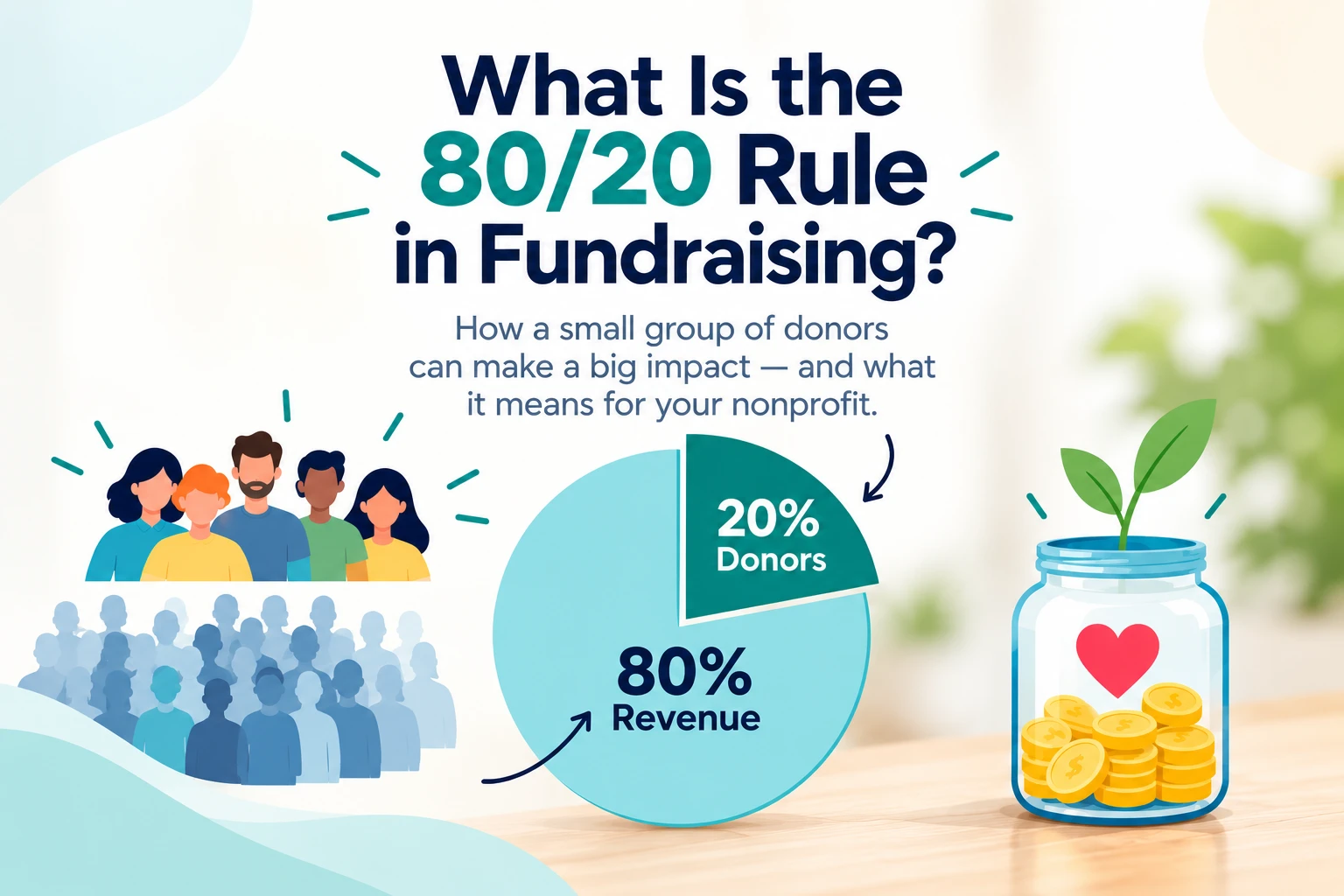
What if a small group of donors is responsible for a surprisingly large share of a nonprofit’s revenue?
That’s the basic idea behind the 80/20 principle: a relatively small group can produce a disproportionately large result. In fundraising, it can mean that a small percentage of donors provides a large share of the money a nonprofit raises.
But is the 80-20 law really a law? And should nonprofits actually build their fundraising strategy around it?
The answer is more nuanced. 80/20 can reveal revenue concentration, but it does not tell you which supporters matter most.
Understanding that difference can help nonprofits move beyond simply finding the 20% and start building stronger relationships across the entire donor ecosystem.
Why Do a Few Donors Often Drive So Much Revenue?
What if a nonprofit could raise more money while actually having fewer people supporting it?
Current Fundraising Effectiveness Project data shows exactly this tension: charitable dollars increased an estimated 4.3% in Q1 2026, while the number of donors fell 0.8%.
More money sounds like good news.
But when revenue grows faster than participation, it is worth asking where that money is coming from.
How much of a nonprofit’s fundraising depends on a relatively small group of donors?
That question leads us to the 80/20 rule, a principle often used to describe how a small share of donors can account for a large share of fundraising revenue.
The 80/20 “Rule” Isn’t Quite a Rule
If it is called the 80-20 law, shouldn’t every nonprofit roughly follow it?
Not quite.
The idea of 80/20 comes from Italian economist Vilfredo Pareto, who observed an uneven distribution of wealth in Italy in the late 19th century. His observation later became known as the Pareto Principle and was applied far beyond economics, including business, management, and nonprofit strategy.
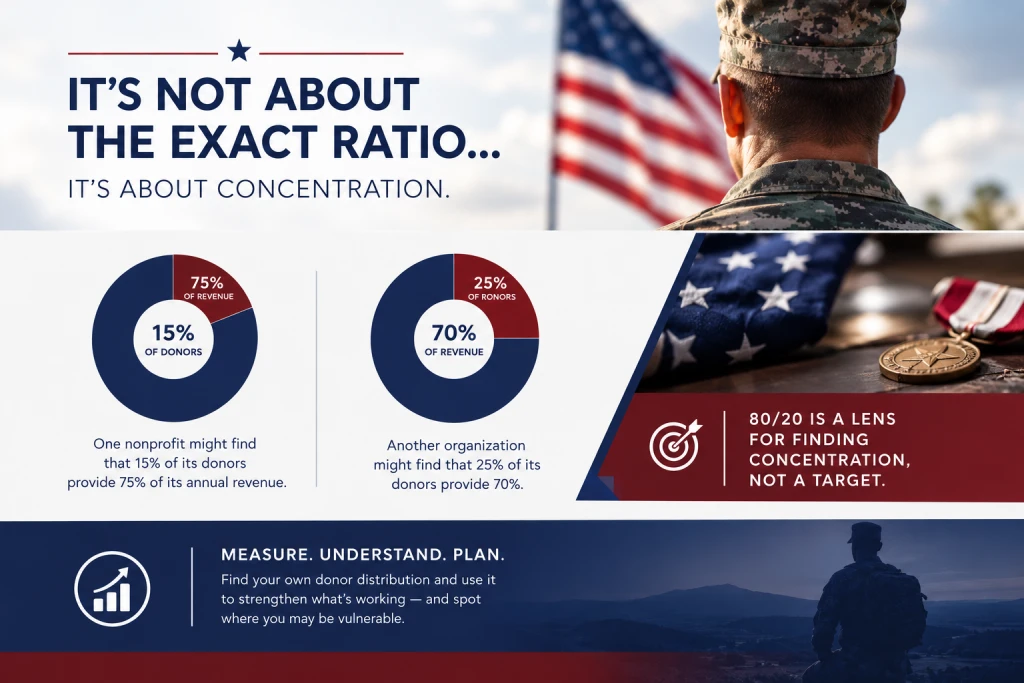
For fundraisers, the useful part isn’t the exact ratio. It is the idea of concentration.
Imagine a nonprofit discovers that 15% of its donors provide 75% of its annual revenue. Another organization might find that 25% of its donors provide 70%. Both show concentration, even though neither fits a perfect 80/20 pattern.
That distinction matters.
80/20 is a lens for finding concentration, not a target your nonprofit has to hit.
Historical research into nonprofit fundraising has examined whether giving follows Pareto’s principle and found that organizations can show different patterns of donor concentration.
The next step isn’t to copy someone else’s 80/20 statistic. Measure your own donor distribution and use it to understand where your fundraising is strong and where it may be vulnerable.
What If Your “20%” Is Actually Smaller?
If 20% of donors can generate most of a nonprofit’s revenue, what happens when that concentration becomes even stronger?
You might see a 90/10, 85/15, or even 95/5 pattern.
That can happen when a nonprofit receives major gifts, planned gifts, corporate or foundation nonprofit funding, or large one-time donations. Long-standing relationships with wealthy donors can also push revenue toward a smaller group, especially when fewer smaller donors continue giving.
This does not mean every nonprofit is becoming 90/10.
It does show why concentration deserves attention.
Consider two organizations:
- Organization A: The top 20% of donors provide 80% of revenue.
- Organization B: The top 10% provide 90% of revenue.
Both may have strong fundraising numbers. But Organization B has more of its revenue tied to fewer relationships. If several of those donors stop giving, the financial impact could be much greater.
That is the part fundraisers should pay attention to.
A nonprofit shouldn’t chase a particular ratio. It should track how its own concentration changes over time. As the percentage of revenue coming from a smaller donor group increases, concentration risk can increase too.
The goal isn’t to eliminate major gifts. It is to understand how much your organization depends on them and make sure strong revenue today doesn’t hide a less resilient donor base tomorrow.
The Biggest Mistake Is Thinking the Other 80% Don’t Matter
If your biggest donors give most of the money, your attention will naturally tend to shift toward them.
That is where the 80/20 principle can be misunderstood.
Major donors often deserve depth. That can mean personal stewardship, meaningful impact updates, relationship mapping, thoughtful asks, and regular communication that goes beyond another donation request.
But the broader donor base needs breadth.
That means investing in donor acquisition, recurring giving, re-engagement, community participation, volunteer opportunities, mission education, and advocacy. These supporters may not generate significant revenue today, but they can become much more valuable over time.
A donor relationship usually develops step by step.
First, someone learns about your organization. Then they interact with your work and make a first gift. If you communicate well and show them the impact of their support, they may give again. Over time, they may become a recurring donor, volunteer, advocate, or major donor.
A person who gives $25 today to help military families feel supported may become a monthly donor next year. They could also volunteer, introduce your organization to a community partner, advocate for your mission, or eventually make a much larger gift.
So the answer isn’t to choose between major donors and everyone else.
It is to give each group the kind of engagement it needs.
The simple takeaway
Major donors may give more money, so they need personal attention and careful relationship-building.
But smaller and newer donors matter too. They may give more in the future, become regular donors, volunteer, or recommend your organization to others.
So, do both:
- Give major donors personal attention.
- Keep building relationships with all your other supporters.
The 80/20 rule can help you decide where to spend more time, but it should not make you ignore the people who give less today.
A Bigger Donation Doesn’t Always Mean a Better Donor
Imagine two people.
One has the capacity to give $100,000 but has never shown much interest in your mission.
Another gives $1,000 every year, volunteers, introduces people to your organization, and consistently stays involved.
Which relationship is more valuable?
You cannot answer that from wealth or gift size alone.
A donor’s value has several parts:
- Capacity: Can they give more?
- Affinity: Do they care about your mission?
- Intent: Do they want to support your work?
- Relationship: Do they trust your organization and stay engaged?
A donor who gives $1,000 every year may have greater long-term value than someone who makes one large gift and never engages again.
This does not mean ignoring major donors. Their financial impact can be significant, and strong stewardship matters. It means looking at the whole relationship before deciding where to invest your time.
What If Rising Revenue Is Hiding a Weaker Donor Base?
A nonprofit raises more money. At first glance, that looks like a healthy fundraising year.
But what if fewer people are giving?
That is the difference between fundraising performance and fundraising health.
Fundraising performance looks at numbers such as:
- Dollars raised
- Campaign targets
- Average gift size
- Major gifts
Those numbers tell you what happened this year.
Fundraising health asks a bigger question: Can those results continue?
For that, nonprofits also need to watch donor count, retention, new-donor acquisition, repeat giving, recurring donors, revenue concentration, and donor lifetime value.
The lesson is not that rising revenue is bad. It is that one strong number can hide another problem.
Revenue tells you what came in. Donor health tells you if the relationships behind that money can last.
Try asking two simple questions:
- If your top 10 donors stopped giving tomorrow, what percentage of your annual revenue would disappear?
- If you stopped acquiring new donors for a year, would your current donor base be large and engaged enough to sustain you?
The Smarter Way to Use 80/20: Measure, Protect, Develop, Broaden, Connect
So, what should a nonprofit actually do with the 80/20 principle?
Use it as a diagnostic tool. This five-step framework can help you understand where your fundraising is concentrated without treating 80/20 as a rule you have to follow.
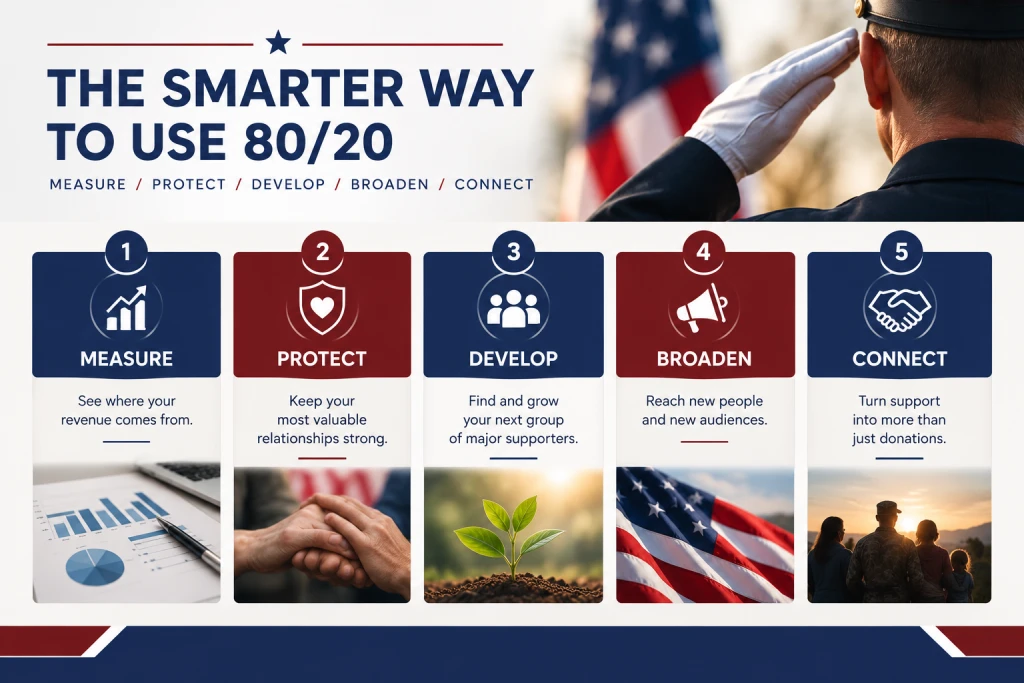
1. Measure: Who gives what?
Start with your own donor data. Track how much of your revenue comes from your:
- Top 1%
- Top 5%
- Top 10%
- Top 20%
- Top 50%
Then compare each group’s share of revenue, number of gifts, and lifetime giving. Review these numbers each year. A single year’s results can be useful, but the trend can tell you much more.
Also read:
How to Support a Military Family During Deployment
How to Choose a Military Charity Worth Donating To
2. Protect: Which relationships are financially critical?
If a small group provides a large share of your revenue, those relationships deserve careful stewardship.
Create a simple plan for staying in touch with major donors through personal updates, impact reports, thank-yous, and regular check-ins.
Not every conversation needs to end with an ask.
3. Develop: Who could become more valuable?
Look just below your top tier.
You may find consistent donors, recurring donors, increasing donors, highly engaged supporters, and people who have stayed with your organization for years.
These supporters could become your next group of major contributors.
4. Broaden: Who isn’t participating yet?
This is where broader nonprofit marketing strategies come in.
Use content marketing, email, community outreach, events, partnerships, and nonprofit digital advertising to reach people who haven’t connected with your mission.
The goal isn’t to ask for money immediately.
First, give people a reason to learn about your mission, understand its impact, and feel connected to the work.
Once that connection grows, they may choose to give, volunteer, attend an event, or support your mission in another way.
5. Connect: What does support look like beyond money?
This is where fundraising becomes bigger than fundraising.
Someone may give, volunteer, introduce others, attend an event, advocate for your cause, or stay connected to the mission.
For a community-focused nonprofit organization like ASA USA, support can also mean helping strengthen connections with military units and families throughout the year.
The Real Value of 80/20 Isn’t the Number. It’s What You Do With It.
At the beginning, we asked a simple question: What if a nonprofit raises more money while fewer people are giving?
Now the answer is clearer.
The 80/20 principle can help reveal where fundraising revenue is concentrated, but it is not a fixed law. A 90/10 pattern isn’t automatically the new rule either.
Major donors matter, but smaller donors can hold different kinds of value. And rising revenue does not always mean a healthier donor base.
The healthiest fundraising strategy isn’t simply about finding the people who can give the most. It’s about building relationships that keep people connected to the mission.
For a military-community nonprofit organization like ASA USA, that means support shouldn’t appear only around a holiday, ceremony, or headline. It can mean creating ongoing ways for communities to stay connected to service members, military units, and military families.